
Class 201A – Orientation
TABLE OF CONTENTS
Division I – General Information and Introduction
- Section 1: Background, Purpose, Expectations
- Section 2: Description of School
- Section 3: Diplomas and Transcripts
- Section 4: Rewarding Men for what they Should and Would Do
- Section 5: The Great Commission
Division II – The Scripture Work
- Section 6: The Necessity of Scripture Work
- Section 7: Salvation
- Section 8: Distribution
- Section 9: Assembly
- Section 10: Publishing
- Section 11: Working Together
- Section 12: Teaching
- Section 13: Scripture Research and Translation
- Section 14: Evolution of Scripture Work
Division III – Commandment Doctrine
- Section 15A: Teaching Doctrine – Based on Jesus’ Doctrine
- Section 15B: The Doctrine of “Whosoever Will”
- Section 16: What We Do and Teach
- Section 17: Law vs. New Testament
- Section 18: Reproduction
- Section 19: Being a Pattern to Follow
- Section 20: Love Commandment Doctrine
- Section 21: By Love Serve One Another
- Section 22: No Debt Principles
- Section 23: Inter-church Service
Division IV – Curricula and Associated Information
- Section 24: Curricula Explained
- Section 25: Pyramid
- Section 26: Need for Practicum
- Section 27: Doers of the Word
- Section 28: Teaching to be in the Heart
- Section 29: Whosoever Will
- Section 30: Syllabi Work and the Need for Writing
- Section 31: Credit
- Section 32: Class hours
- Section 33: Diplomas
- Section 34: Syllabi Availability
- Section 35: Syllabi Creation and Translation
- Section 38: Post-Doctorate Work
Division VI – Curricula Details
- Section 42: Associates
- Section 43: Graduate
- Section 44: Bachelor
- Section 45: Masters
- Section 46: Doctoral
- Section 47: Post-Doctorate Work
Division VII – Miscellaneous Comments
Introduction
And Jesus came and spake unto them, saying, All power is given unto me in heaven and in earth. Go ye therefore, and teach all nations, baptizing them in the name of the Father, and of the Son, and of the Holy Ghost: Teaching them to observe all things whatsoever I have commanded you: and, lo, I am with you alway, even unto the end of the world. Amen.
Matthew 28:18-20
The Orientation class summarizes the entire Baptist International S.O.S. program in as few pages as needed so the student understands generally the content of the classes, his path in the program, and the scriptural concepts followed in creating the university-level teaching.
This is the third revision to the School of the Scriptures (S. O. S.) Orientation. Is was previously called SP-108, but we have updated the class designation to 201 Orientation. This was done to integrate and align the syllabus with the whole system of the Baptist International teaching.
The first Orientation was written in the early 1970’s by D. M. Fraser, D.D., Ph.D.; and is available as a reference document with the school. D. M. Fraser was the creator of the curricula and head of Baptist Christian University International (now called Baptist International – B. I.). He is also unequivocally the father of Bearing Precious Seed (although he rejected the title), as men involved in this work will testify.
The second (Revised SP-108) was written in July 1993, by Nash Sebastian Desent, Ph.D., Th.D., D.D.; pastor of Historic Baptist Church. This document is also available for reference upon request.
This third and most recent Orientation, compiles and organizes the information gained over the life of the university and puts it in an easy-digestible format. There are also minor adjustments made in the school and the curricula in order to keep up with technology and real-world changes.
This Orientation (Class 201) to Lead at Every Level
The teacher will notice when perusing the curricula details that this orientation is taught at the beginning of each level. This is repetition for many, but it puts into perspective the purpose and work of the university. Furthermore, it will become more and more familiar to the student. We know that repetition is the mother of learning. Baptist International uses repetition and overlap throughout the curricula to reinforce the teachings.
The Baptist International Handbook (Class 000A) is a manual for the school and it should be supplied to and reviewed by the students before starting the Orientation. The Handbook will explain many things and answer many questions the students will have. Before starting the following Sessions, the teacher should spend some time teaching on the importance and fundamental application of the Great Commission and ask the students if there are any issues that need clarification.
Division I – General Information and Introduction
Section 1: Background, Purpose, Expectations
Baptist International was initiated and commissioned as a Bible-based curriculum for Baptist Christian University International in 1972 by then-Chancellor Dr. Jimmy Gid Tharpe (May 12, 1930 – November 25, 2008). Dr. Tharpe was also pastor of Baptist Tabernacle in Shreveport, LA.
Although initiated by Pastor Tharpe for B. C. U. I. in 1972, the curricula were already being developed for about ten years by Dr. Donald McLeod Fraser (August 8, 1926 – December 9, 2003), the Father of Bearing Precious Seed. Bro. Fraser was a missionary out of First Baptist Church in Fort Worth, Texas, as was his father, who served under J. Frank Norris (John Franklyn Norris, the Texas Tornado, September 18, 1877 – August 20, 1952). J. Frank served 44 years as pastor of First Baptist from 1909 to his death in 1952.
Bro. Fraser lived in Bowie, TX, and he originated and used for his work the names Baptist International, School of the Scriptures, and Bearing Precious Seed, during the work of his ministry, 1962 – 1989, and afterwards.
Bro. Tharpe wanted a pure Bible-based program, which Bro. Fraser turned over to him as a finished product in 1989. At that time, N. S. Desent was on staff at Baptist Tabernacle and took over the school in Louisiana, then called Baptist Christian University, International. We changed the name to Baptist International shortly thereafter.
The curricula were already named School of the Scriptures (S. O. S.) and the complete program has been taught since 1989 by N. S. Desent, and previously during its 27 years of development (1962 – 1989) by others. The curriculum is fully Bible-based in its purpose, content, order of teaching, and manner of teaching.
We expect, have experienced, and continue to work towards, the curricula being used world-wide in independent Baptist churches to train men for the ministry.
Every independent Baptist church should be responsible for the training of their men who are called into the ministry. The curricula allow churches to freely fulfill this responsibility, avoiding the hypocrisy found in many institutions.
Section 2: Description of School
The school is tuition-free. All materials are NOT FOR SALE and offered free of charge. This fulfills one of the many scriptural requirements for a scriptural school. The only required textbook is the Holy Bible (AV1611 in English, other languages use T/R and Masoretic-based translations). Some scripture comparisons will be required, so a variety of other translations and versions are used so the student learns the problems with other versions. The school operates under the authority of the local church teaching the curricula. This allows independent churches the liberty to teach as they are led of the Holy Ghost.
The pastor is both the teacher and a student of the word of God.
Teaching schedules are determined for each class by the teacher. Depending on work schedules and other obligations, the times will vary. Historically, we choose one to three nights a week for class, approximately three hours long. This way, the normal 18-hour class requirement is finished in roughly six weeks.
However, depending on the level of understanding of the student, the classes can be shortened or lengthened.
Similarly, as with the schedule, the class location is also flexible. We have met in church buildings, homes, and on trips. The program’s flexibility works well with men who work secular jobs.
To fulfill the requirements of the university, each class requires as a minimum 18 class hours of teaching for every credit hour. Practicum is also required. Each church will establish for its students the required practical work.
Section 3: Diplomas and Transcripts
Following the standard for universities, a man can issue diplomas up to his level of education. For example, a man with a bachelor’s degree can issue diplomas in that same discipline up to the bachelor level. A man with a master’s degree can issue diplomas in that same discipline up to the master’s level. A man with a doctorate can issue up to the doctorate level.
For men starting seminaries in their churches, they should earn their diplomas through Rhode Island Baptist Seminary, and then they can confer diplomas to the men they teach. Men can use the Rhode Island Baptist Seminary diploma as a template (supplied with their diploma) and modify depending on the school, student’s name and language, and date of graduation.
For transcripts, the classes completed (the basic curriculum) is printed on the reverse of the diploma so the student always has a copy independent of the school. The transcript also provides a class list should the
teach the curriculum in the future.
We encourage students to finish the master’s level curricula before issuing diplomas to students, but this is not a requirement.
Section 4: Rewarding Men for what they Should and Would Do
Because the school is biblically based and intended for ministers, most requirements would be fulfilled generally by a diligent servant of God during his life as a minister. The man who uses the program will accomplish these objectives in a more efficient and organized manner.
The school rewards and recognizes the accomplishments of each student.
For this reason, the credit for Practicum is assumed to be fulfilled regardless of whether a man is in the school or not. However, for the sake of record keeping, we ask that the student keep track of the practicum work.
Section 5: The Great Commission
The school understands the Great Commission of our Savior Jesus Christ as found in Matthew 28:18-20 is the purpose, objective, and over-arching principle on which the curriculum is established.
Using the illustration of the B. I. Teaching Pyramid, one can see that the first two levels that represent the first two parts of the Great Commission – salvation (i.e., “teach all nations”) and baptism (i.e., “baptizing them…”) are fulfilled first, before starting the third part – teaching them to observe all things whatsoever Jesus has commanded.
Because it is the church’s duty to authorize preachers of the gospel and her baptizers, this shows the school is developed for use in Baptist churches. As the commandments of our Savior are observed and taught (“do and teach” – Acts 1:1), the obedient servant learns and leads.
The B. I. program is based on the great Commission of our Savior. Sadly, although many churches are faithful to spread the gospel and baptize converts, some are lacking in an organized and serious method of teaching these converts to “observe all things” Jesus Christ has commanded.
The classes at the associate level teach Jesus’ commandments divided in certain areas of life – service, prayer, finances, evangelism, teaching, language, family, scripture work, etc.
As the student progresses, he creates a comprehensive list and commentary on Jesus’ commandments (bachelor level). All the while, as he understands more and more the order of authority, the student is expected to be obedient to the commandments of Christ and be subject to his local church.
Division II – The Scripture Work
Section 6: The Necessity of Scripture Work
No work of the Lord cane rightly done without honoring and preaching and teaching the word of God. Without the Bible, we have nothing to say or do.
Furthermore, it is the New Testament in particular that we observe to do and teach (Acts 1:1), specifically, the commandments of Jesus Christ.
One precept (a first commandment) is to get the word to those who do not have it. Romans 16:26 says the gospel is made known to all nations by the scriptures. For we preach not ourselves, but Christ Jesus the Lord (2 Corinthians 4:5). Jesus taught this with his ensample as the Sower with the Seed. The seed is the word of God (Luke 8:11).
The B. I. curricula teach and require manuscript research for the identification of departure texts, publication and distribution of the correct texts, and translation of the correct texts into languages as needed. The curricula also require a “by love serve one another” model (Galatians 5:13) to have brethren of like faith work together for the publication and propagation of the New Testament.
For the work in Peru and in other areas, because some areas are remote and the people are scattered, we have adjusted the scripture requirements in respect to distribution from a tonnage model to a saturation model.
Students will be required to do their due diligence in scripture research and distribution.
Section 7: Salvation and World Evangelism
Because of the Romans 16:25-26 mandate, we are commanded to make known the scriptures to all nations, for the purpose of salvation – the obedience of the faith. For this reason, we concentrate first on the Gospel of John and Pauls’ Epistle to the Romans. Both of these books have historically been proved to be expedient for the winning of lost souls to Jesus Christ. These are two witnesses that have a long history of being used for world evangelism. In some cases, the use of the Gospel of John alone is sufficient.
Additionally, the books of John and Romans (J/R’s) are suitable for long-term study and discipleship. Our Class 101 Church Discipleship Guide has been developed to be used with John and Romans. One will notice the title of each lesson also has scripture references found in John and Romans.
Salvation is the first work we do as Gospel Ministers. We must go “to every creature,” and preach the gospel to them. Hand in hand, the sower and the word, go forth in our Savior’s footsteps
The availability of the gospel to all men so that they may be saved is very necessary and a required work in the school. Not only is the practical work of evangelism required, but students will be required at the higher levels to write papers on evangelism in their “Jerusalem.” This is a noteworthy task as each pastor and area of service offer good advice and experience as to how to reach these communities with the gospel. What works in one area may not work in another area.
Section 8: Distribution
The free distribution of the scriptures is the first step in the scripture work after the obvious work of reading and study for one’s own growth, and the preaching and teaching of it required of the man of God.
People who do not have a copy of the scriptures are as lost people without light and without a compass. They have no comfort, hope, or truth. The preacher – as faithful and diligent in teaching as he is – cannot fulfill the necessity of God’s word in a person’s life. The sower sows the word. The seed is the word of God. Without the word, the sower’s work is vain.
The involvement in Scripture Distribution will show the pastor and his church the end result of the scripture work: Souls saved, people edified, saints encouraged, and God glorified.
Section 9: Assembly
With successful distribution of the word of God, the preacher will at some point realize that these booklets of John and Romans have a source. They have to be made and delivered and then distributed. With the understanding of how the scriptures are used, the man of God should then participate in the assembly of the booklets. As the scripture work is always made without charge, the labor of faithful church members to help in the assembly of scriptures is always needed. Scriptures are distributed free of charge, but there is a cost to their production. This cost is the responsibility of God’s people. The anagram B. P. S. stands, not only for Bearing precious Seed, but also for Baptists Publishing Scriptures.
Section 10: Publishing
The assembly of the scriptures takes for granted that the printed material is available. In cases where it is not available, the preacher must get the paper printed. The texts for John, Romans, and the New Testament are available for publication on our website.
This is a work for the mature Christian for it requires vision, diligence, and in many cases, money. In today’s world with the availability of computers and printers, almost anyone can publish the scriptures. Love for the lost and love for God’s word are the motivating factors in scripture publishing.
The B. I. Curricula teach the need for publishing scriptures and other works that edify the body of Christ.
We encourage every student to print booklets of John and Romans. Whether as a church-led effort or at an individual level, the scriptures need to be published and distributed. We offer the .pdf versions on our website and these can be printed with little effort using common home printers.
If every gospel-preaching church took the commandment to publish the scriptures to heart, we would have a great sufficiency of God’s word for world-wide distribution.
Section 11: Working Together
Baptist International recognizes and honors the independence and autonomy of every Baptist church. We presume no authority over them; neither do we diminish their authority. We are servants who “by love serve one another” (Galatians 5:13).
Acknowledging the autonomy of every church, B. I. is available for pastors to learn and earn degrees. Once the degree is obtained, the pastor is positioned to grant degrees in the same curriculum up to his level.
For foreign works, the curricula are available and able to be translated in 70 languages. Pastors and missionaries located internationally can generate syllabi in their language and start Seminaries in their churches. By initiating a school and teaching the material, the pastor earns credit while he teaches.
Also, with the scripture work, there are ample opportunities to work together for scripture printing, assembly, and distribution.
Section 12: Teaching
Because Satan has corrupted some manuscripts of the word of God, it is necessary that we teach students how to identify departure texts and prove right texts by the multiplicity of testimony.
This teaching also extends to the distribution, assembly, and production of the correct scriptures.
Section 13: Scripture Research and Translation
We will teach students how to research and identify correct scriptures. However, when there is not a correct version in a particular language, it is incumbent on the student to translate the scriptures into the language that is needed. This may be a rare case to some works, but common to others. We contend the Baptist Missionaries working among the remote tribes and strange dialects are the best people to translate evangelistic material, including portions of scripture.
When translating the New Testament, the source text must always be the original language (Greek). We use and promote the Textus Receptus, specifically as found in Beza’s Greek New Testament of 1598.
When translating the Old Testament, the source text must always be the original language (Hebrew). We use and promote the Masoretic Hebrew Text.
As a side note, we reject the Septuagint (LXX) as having any authority in respect to Bible translation or the identification of correct texts. The Septuagint is simply the Old Testament in Greek as found in Codex Vaticanus (B), which we know is corrupt and the basis for many departure texts.
Section 14: Evolution of Scripture Work
The evolution of the scripture work can be simplified as follows:
A man gets saved by believing the word of God – specifically the Gospel of Jesus Christ. He reads the word of God and through obedience brings forth fruit.
At some point, the man has a desire to win others to Christ, and he uses the word of God to show people how to be saved.
He realizes the need for scripture in order feed believers and to further win souls to Christ, so he obtains copies of the scriptures to use in soul-winning and discipleship.
He then gets further involved in procuring more copies of the scriptures for distribution to those without.
He learns the need to produce the scriptures for distribution and encourages others to do the same. He becomes a leader and a teacher of the scripture work.
God may open a door at some point for this man to translate the word of God into a needed language.
Briefly summarized, here is the progression:
- Distribution
- Assembly
- Production
- Teaching (reproduction)
In respect to the creation and use of the scriptures, this is the progression:
- Learn the word
- Identify the need for scriptures
- Identify the correct scriptures
- Raise funds for publishing the word
- Produce the correct scriptures
- Distribute the scriptures to those who will read them
- Win souls as God commands
- Train workers for reproduction
The mature Christian understands the three-fold use of seed as described in 2 Corinthians 9:9-10:
9 (As it is written, He hath dispersed abroad; he hath given to the poor: his righteousness remaineth for ever.
10 Now he that ministereth seed to the sower both minister bread for your food, and multiply your seed sown, and increase the fruits of your righteousness;)
The three uses of the word of God are these:
- Daily food – personal bible reading, study, and development
- Basis for multiplying and sowing the seed (copying, publishing, distributing, teaching, etc.)
- Increase the fruit of righteousness – becoming a better and more obedient Christian, having future rewards.
Division III – Commandment Doctrine
Section 15A: Teaching Doctrine – Based on Jesus’ Doctrine
Our responsibility as disciples is to follow Christ. We forsake all and follow him. He is our Master. He is our Rabboni. He is our Lord. He is Alpha and Omega, the Author and Finisher of our faith.
We do and teach Jesus’ Doctrine (Acts 1:1; Matthew 28:18-20). Jesus’ doctrine contains his commandments – the Commandments of Jesus Christ. The first and foremost commandments (basic) are called precepts. We have listed our top ten commandments of our Savior for reference below (a complete list is supplied in the curriculum):
1 Believe on the Lord Jesus Christ 1 John 3:23; Matthew 7:13; John 3:7
2 Be scripturally Baptized Matthew 28:18-20 *
3 Love one another as Jesus loved 1 John 3:23; John 15:12; Matthew 5:44
4 Learn of Jesus (follow him) Matthew 11:28-30
5 Be a testimony and witness for Jesus Christ Matthew 5:16; Acts 1:8
6 Be perfect (strive for holiness) Matthew 5:48
7 Be forgiving Matthew 6:14, 15
8 Seek first the Kingdom of God Matthew 6:33
9 Lay-up treasures in Heaven Matthew 6:20-34
10 Be merciful and forgiving Matthew 7:1-12
* Baptism is given to church leadership to perform correctly. It is not given to baby-believers to seek out in their own limited understanding.
Doctrine is to be first obeyed then taught. We do not, “say and do not” as the hypocrites did in Jesus’ day (Matthew 23:3).
Doctrine matures the believer. Doctrine helps the believer. Doctrine gives understanding to the believer (Psalm 111:10).
For Baptist churches, the Great Commission is a Precept. As one meditates on this mandate found in Matthew 28:18-20, he will realize God commands his church to “teach all nations.” How is he to fulfill this commandment? By God’s grace we offer a program that a man can use and recommend to the missionaries he supports.
Section 15B: The Doctrine of “Whosoever Will”
One great tenet of the Lord’s teaching is that “Whosoever Will” can be saved. We have written a large paper on this subject found in the syllabus for Class 310 on World Evangelism. We must keep in mind God is no respecter of persons and reject Calvinistic error.
Section 16: What We Do and Teach
Even a child is known by his doings. We are known by what we do. Our doctrine is not what we believe – our doctrine is what we do. We really show what we believe by what we do (1 Samuel 2:3). Consequently, right leaders will be obedient to Jesus’ commandments before they teach.
Students must learn and do all things whatsoever Christ commanded. They must have a world vision for their evangelistic work. The must do before teaching. They must be good patterns to follow.
Section 17: Law vs. New Testament
We understand the Law was given by Moses, but grace and truth came by Jesus Christ (John 1:17). The law is a schoolmaster to bring us to Christ. Once we are under Christ, we are no longer under the schoolmaster (Galatians 3:24, 25). The law is made for the disobedient (1 Timothy 1:9). We who are saved are under grace and we follow the New Testament Doctrine of Christ – not the law of Moses.
Baptist International teaches Jesus’ Doctrine, which is far superior to Moses’ Doctrine. This difference is shown in the contrast of our Savior to the Pharisees. We train disciples of Jesus Christ, not pharisees.
Section 18: Reproduction
We always reproduce. A field can reproduce thorns, or it can reproduce good fruit. A family can reproduce God-fearing children, or it can reproduce rebellious reprobate children. But it will reproduce.
A man can only reproduce what he is. A man will reproduce what he is. If unfaithful, that is what he will reproduce in those who follow. If he is legalistic and critical, that is what he will reproduce in his followers. If he is obedient to Christ, that is what he will reproduce in his followers.
This is why we “do and teach.” Our Savior wants us first to be (believe), then do (doctrine), then go and teach (go with the gospel). To further illustrate this required principle, you will find that anything that was commanded by our Savior or his apostles, that these men first obeyed the doctrine themselves before teaching or commanding others to do it. This we can be sure of. We have no room for hypocrisy, which is a doctrine of Pharisees.
One can summarize the progression as follows (more on this subject in found the Class 229 syllabus on Doctrine of Scriptural Reproduction):
- Look
- Listen
- Learn
- Labour
- Live
- Love
- Lead
- Leave
Section 19: Being a Pattern to Follow
The end objective of our life is to be a right pattern for others to follow. We are to be ensamples to flock, not lords over God’s heritage (1 Peter 5). As a pattern to follow, we strive for personal holiness, evangelism and soul-winning, and discipleship of those God has given us. This is where the rewards of gold, silver, and precious stones are found – in dealing rightly with those around us.
Section 20: Love Commandment Doctrine
The greatest commandment (or precept) is to Love God and Love One Another. This is a simple commandment, but a commandment that must be obeyed every day, in every way, and at every level. There are many things related to this commandment. All the law and prophets hang on these two commandments. All the New Testament hangs on this commandment (John 3:16).
Love is the reason we do what we do in the Lord’s work. Love is the reason we keep the Lord’s commandments (John 14:15). Love is a commandment of the Lord (John 15:12, 17).
Section 21: By Love Serve One Another
Considering the section right above, we understand the means for inter-church service is by love (Galatians 5:13). We give of our resources (time, money, energy) to be a blessing to other believers and other churches. We produce and distribute scriptures and offer teaching at no charge to the people without.
Section 22: No Debt Principles
Based on scripture, B. I. teaches a no debt principle – especially for the ministry, the church, and the work of the scriptures. Because the borrower is servant to the lender (Proverbs 22:7), we want to keep God’s work independent of any other master (mammon).
We believe God provides for what he commands.
Personal debt is also to be avoided. We understand the world operates on debt, and most households and business operate in debt. These issues are discussed in detail in Class 204 Christian Principles of Finance in the Associate curriculum.
We show that short-term covetousness = long-term debt to most people. However, the use of other people’s money (OPM) to produce cashflow in a business venture is worthy of discussion (Luke 16:8; 19:13).
The opposite of debt is abundance and through abundance we can do the work of helping others with financial recovery (kinsman redemption). God does not want us in debt, or even just at equality – God wants us to learn to operate in abundance.
Section 23: Inter-church Service
Inter-church service is necessary in the work of the Lord and especially in the scripture work. Our churches are independent and autonomous; however, we operate in love serving one another (Galatians 5:13) to promote the work of God in a greater way.
The support of missions, the scriptures, and edifying other churches is all required activity of the Lord. The best ensample of this I think is the apostle Paul. He traveled throughout the known world in order to preach the gospel and edify the churches.
Division IV – Curricula and Associated Information
Baptist International School of the Scriptures (S. O. S.) is a university level teaching program that was developed with these objectives in mind:
- Our Goal: Reaching the World for the Lord Jesus Christ – the Great Commission (Matthew 28:18-20).
- Teaching students to have a World Vision (Mark 16:15; Luke 24:47)
- The Bible is the only textbook (based in the Bible) 2 Timothy 3:16
- The program teaches the biblical things that should be taught in the biblical order they should be taught, in the biblical manner, and for the biblical objective.
- Teach Scriptural Doctrine.
- Never violate scriptural doctrine when teaching.
- The program can be used in any place, any language, any time (international and inter-time).
- The program is designed for local Baptist churches to teach their faithful men the things they most need for the work of the ministry. Schools operate under local church authority. The local church is the headquarters and authority for all teaching, preaching, baptism, and ordination (1 Timothy 3:15). The churches are autonomous embassies of the Kingdom of Heaven that operate according to the laws of their King – Jesus Christ.
- The program is centered on Jesus Christ and his commandments (his doctrine). The student is taught and learns how the Great Commission is fulfilled rightly.
- The curriculum takes a student from “saved and baptized” to Doctorate level work.
- Degrees Offered:
- Associate of Scripture Ministries
- Graduate of Theology Scripture Ministries
- Bachelor of Theology Scripture Ministries
- Master of Arts Scripture Ministries
- Doctor of Philosophy Scripture Ministries
- Students can enroll and identify their level. Every student is responsible to teach all lower level curricula. Men are divided into four types:
- Mainliners – Men from S. O. S. and who have a previous history of work-related experience related to B. P. S. These men were involved in curricula writing or translation over the previous decades. Many of these men offer variations of the School of the Scriptures program.
- Development Men – Prior Degreed in non-S. O. S. studies, but previously and currently involved with S.O.S. work and curricula development.
- In-coming Graduate Men – Prior Degreed in non-S. O. S. studies with no S. O. S. work. Individual evaluation needed. These men should have a heart and desire for the S. O. S. program and be willing to learn and develop the S. O. S. curricula via class and self-directed work and other involvement.
- Post-Doctoral Men – Experience and History in S. O. S. and B. P. S. work. Degrees earned through S. O. S.
- The teaching for students to be organized per the B. I. Teaching Pyramid.
- Materials Need for Student to enroll are minimal:
-
- Whole Bible (AV1611 in English)
- Access to school curricula via Rhode Island Baptist Seminary website or printed downloads per instructions shown. Men starting Seminaries should enroll via the Minister Portal.
- Work Journal (for notes and record-keeping)
- Website: www.RhodeIslandBaptistSeminary.org
- Starter List of Necessary Downloads
-
- Whole Bible
- John and Romans booklet
- 000A School Information and Handbook (B. I. Manual)
- 000B Pyramid Diagram
- 000C Pyramid Notes
- Class 101 Church Discipleship Guide
- Class 200 S. O. S. Compendium
- Class 201A Orientation (this document)
Translation for all materials available in 70 languages. See the Seminary website for instructions.
Section 25: Pyramid
The Baptist International Teaching Pyramid is in no way connected with Egyptian religion or any other worship. It is simply a diagram showing the relationship of the number of people to the particular levels of understanding and involvement in Baptist International. There are more people at the lower levels, and people at the higher levels.
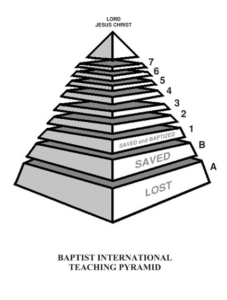
Baptist International Teaching Pyramid
(Follows Isaiah 28:9, 10 – “Precept upon precept, precept upon precept; line upon line, line upon
line; here a little, there a little”)
Base – Designation A:
- Level Identification: The Lost.
- Commanded Activity: OBEY GOSPEL
- Represents the LOST. These are not born of the Spirit. The Natural man cannot receive the things of the Spirit (1 Corinthians 2:14). No man can say that Jesus is Lord but by the Holy Ghost (I Corinthian 12:3). The person has no or very little Spiritual understanding or wisdom. There are far more people at this level than any other.
- Applicable Teaching: The gospel of Jesus Christ (the first division of the Great Commission). Use of John and Romans.
- Applicable Commandment: Repent and Believe on the Lord Jesus Christ (Acts 17:30; 16:31; 1 John 3:23; 2 Thessalonians 1:8; 1 Peter 4:17).
- Applicable Work of the Minister: Evangelistic Preaching.
Above-Base Level – Designation B:
- Level Identification: Saved, but not Baptized.
- Commanded Activity: BE BAPTIZED – PRECEPT UPON PRECEPT
- Represents those SAVED but not Baptized. These have obeyed the commandment to believe the Gospel. These have the mind of Christ (1 Corinthians 2:16) and have experienced Salvation. These have the Holy Spirit who will guide them into all truth (John 16:13). However, they have not followed the Lord in Baptism.
- Applicable Teaching: Baptism/Church Membership (the second division of the Great Commission). Use of the New Testament.
- Applicable Commandment: Be Baptized.
- Applicable Work of the Minister: Baptizing and Teaching.
Level 1:
- Level Identification: Saved and Baptized – Becoming a Disciple
- Commanded Activity: PRECEPT UPON PRECEPT
- Represents those Saved and Baptized. These have obeyed the commandment to be baptized and are members of a local New Testament Baptist church. This level represents those willing to be disciples, forsaking all that they have for Christ (Luke 14:33). There are fewer at this level than the two lower levels.
- Applicable Teaching: Teaching them to OBSERVE the precepts of all things whatsoever Christ has commanded (the third division of the Great Commission). Use of the New Testament and the Church Discipleship Guide (Class 101).
- Applicable Commandment: If you love me, keep my Commandments (John 14:15).
- Applicable Work of the Minister: Teaching to Observe all things Christ Commanded by Example.
Level 2:
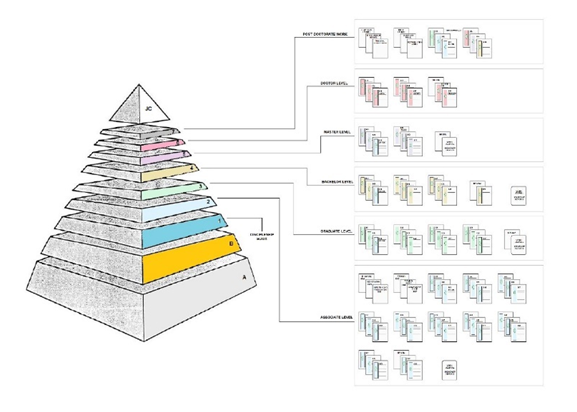
- Level Identification: Associate Level Curriculum
- Commanded Activity: PRECEPT UPON PRECEPT
- Represents those who are learning and obeying the precepts and are being taught “Precept upon Precept.” These men have been involved in the Associate Level teaching by “doing” what they have been taught. These are considered “faithful men” (1 Timothy 2:2). These will be the teachers for the Associate Level program. Work includes Scripture Distribution.
- Applicable Teaching: Baptist International Associate Level Curriculum (Doctrinal Curriculum). Use of Whole Bible.
- Applicable Commandment: Continue ye in my love (John 15:9).
- Applicable Work of the Minister: Teaching to Observe all things Christ Commanded by Example.
Level 3:
- Level Identification: Graduate Level Curriculum
- Commanded Activity: LINE UPON LINE
- Represents those who are obeying the precepts and are being taught “line upon line.” These men have completed the Associate Level teaching by “doing” what they have been taught. These men are considered “faithful men” (1 Timothy 2:2) and strong men (1 John 2:14). These men will be the teachers for the Graduate Level program. Work includes in-depth doctrinal study and Scripture Distribution. These men are working toward fulfilling the basics for learning their churches’ requirements for separated service.
- Applicable Teaching: Baptist International Graduate Level Curriculum. Use of the Whole Bible.
- Applicable Commandment: Love may abound more and more (Philippians 1:8; 1 Thessalonians 4:1).
- Applicable Work of the Minister: Teaching to Observe all things Christ Commanded by Example.
Level 4:
- Level Identification: Bachelor Level Curriculum
- Commanded Activity: LINE UPON LINE
- Represents those who are obeying the precepts and are accomplishing “line upon line.” These men have completed the Graduate Level teaching by doing what they have learned. Work includes Bible Studies and Language and Academics. Also includes Scripture Production work. These men are fulfilling their churches’ final requirements for separated service.
- Applicable Teaching: Baptist International Bachelor Level Curriculum.
- Applicable Commandment: Owe no man anything but to love one another (Romans 13:8).
- Applicable Work of the Minister: Teaching to Observe by Example. Ministry Major identified, approved, and qualifications and gifts being proved.
Level 5:
- Level Identification: Master Level Curriculum
- Commanded Activity: HERE A LITTLE
- Represents those who are obeying the precepts and have accomplished “line upon line.” These men have completed the Bachelor Level teaching by doing what they have learned. Work includes Scripture Language work.
- Applicable Teaching: Baptist International Master’s Level Curriculum.
- Applicable Commandment: Add to godliness brotherly kindness (2 Peter 1:7).
- Applicable Work of the Minister: Teaching to Observe by Example. Language work (Bi-Lingual studies).
Level 6:
- Level Identification: Doctoral Level Curriculum.
- Commanded Activity: THERE A LITTLE
- Represents those who are obeying the precepts and are doing “there a little.” These men have completed the Master’s Program teaching by doing what they have learned. Work includes Scripture Publishing, Translating, Fund-Raising for Missions and Scriptures, Language, and Ministry Finance work.
- Applicable Teaching: Baptist International Doctoral Level.
- Applicable Commandment: Add to brotherly kindness charity (2 Peter 1:7).
- Applicable Work of the Minister: By Love Serving One Another in Liberty (Galatians 5;13)
Level 7:
- Level Identification: Post-Doctoral Research, Work, Administration of Financial Gifts
- Commanded Activity: CONTINUED CONFORMING TO THE IMAGE OF CHRIST
- Represents those who are obeying the precepts and are doing “there a little” and going the second mile. These men are active in International Teaching of the things they have learned. Work includes all scriptural obedience to all commandments and the development of new techniques to fulfill the Great Commission and Administration of the financial and other resource “gifts.”
- Applicable Teaching: Post-Doctoral Research and Work.
- Applicable Commandment: The Greatest of these is Charity (1 Corinthians 13:13).
- Applicable Work of the Minister: Teaching to Observe by Example (to the Uttermost parts).
Top Level:
- Level Identification: The Lord Jesus Christ – King of Kings, Lord of Lords, Head of the Church, Author and Finisher of our Faith. He is the Chief Cornerstone.
- Commanded Activity: JESUS IS FAITHFUL IN ALL THINGS. HE DOES ALWAYS THE THINGS THAT PLEASE GOD (JOHN 8:29).
- Represents the Lord Jesus Christ. Supreme. Complete and full of Wisdom and Understanding. Almighty God. Our Example and we are to be conformed to the image of Christ (Romans 8:29). Christ is the image of the invisible God (Colossians 1:15).
- Applicable Teaching: Jesus’ Work is Completed (Hebrews 5:8). We study him until our work on earth is over.
- Applicable Commandment: Completed (Jesus did always those things that pleased the Father – John 8:29). Greater love hath no man than this, that a man lay down his life for his friends (John 15:13).
- Applicable Work of the Minister: Men cannot reach this level. Jesus alone completed this work and Jesus’ work is forever and perfectly completed (Hebrews 5:8).
Notes:
- The B. I. Pyramid levels represent numbers of people and the amount of spiritual understanding, maturity, obedience, and service.
- Progressing up the teaching pyramid is being conformed to the image of Christ.
- Progressing up the pyramid is achieved by OBSERVING all the Commandments of Christ (“all things whatsoever I have commanded you”).
- No one will ever achieve equality with the Lord Jesus Christ.
- Those at a certain level are responsible to teach others who are below their level. Men at each level should know what is taught at each of the lower levels, be able to teach at those levels, and be actively doing and teaching those levels. He should have the doctrine in his heart.
- Individuals start at the bottom and progress upward.
- Administration sees from the “top” downward.
- Scripture involvement, amounts, and languages progress upward as well.
- Obey Biblical commandments to progress upward.
- Do and Teach the commandments which are commandments (Matthew 28:18-20; Acts 1:1, 2).
- All scriptural teaching occurs at some level. Identify the level at which the student is, and you will know what level of teaching to apply.
Pyramid and Curricula Combined and Illustrated:
Section 26: Need for Practicum
In accordance with the “do and teach” principle of Jesus Christ, B. I. requires practical work for school credit. This amounts mainly to evangelism, scripture work, and ministerial work. The beautiful thing about practicum is that it shows a man is a “doer of the word, not a hearer only” (James 1:22; Romans 2;13).
Having a Practicum requirements helps a man to have better understanding of a subject or theory (Psalm 111:10). For B. I., It is the personal application of the commandment, and this work of obedience is required if a man is to teach others.
The practical work is something a faithful disciple will find himself doing in the work of the ministry already, so it should not be looked at as extra work or credit, but simply a recognition of work already being done.
For pastors and missionaries, the practical work is completed automatically when fulfilling the responsibilities of their ministry major. When teaching their students, each pastor defines what work their student should be doing and assigns the amount of credit.
As an example, the amount of credit earned for door-to-door visitation in a nice neighborhood close to home would be different than evangelizing a remote village that required hours of travel and physical activity to reach. Credit earned for preaching in a children’s program would be different than preaching in a rescue mission.
Keep in mind the work should be promoting the student’s development and experience for the ministry. The teacher should assign practicum for things like church service (help in baptisms, communion services, weddings, funerals, visitation, etc.), evangelism (soul-winning, campaigns, door-to-door work, etc.), and scripture work (distribution, printing, assembly, etc.).
Section 27: Doers of the Word
Each student should put into immediate practice the things which he learns. If there is a commandment he has missed or was remiss in obeying, it is necessary that the student change for the better.
In order to move on to new classes, the student must practice and understand what was taught in the previous classes.
Section 28: Teaching to be in the Heart
One of the great blessing of B. I. is that the Holy Bible is the only textbook. We teach particular subjects in a particular order, but the same book is used. The class syllabi are supplied to be a help and guide on the subject, but there are no divine set of notes. The divine book is the Holy Bible.
A man with the doctrine in his heart should be able to teach indefinitely on the subject using his bible. If the doctrine is loved and lived, he can lead. The syllabi are helpful for men starting and for men new to the program. However, in time, the notes become secondary and he should teach from his heart.
Section 29: Whosoever Will
See also Section 15B.
Baptist International is not a respecter of any person, race, culture, or people. Our ministers are servants, serving one another in love and humility. Our Lord and King is the Lord Jesus Christ and we pattern our lives after him.
In respect to women in the school, keep in mind the curriculum is intended for men to fully prepare them for the ministry. We understand women are not to be bishops. It is the church’s choice whether to include women in the classes. Wives of the students will benefit from the teachings. Churches can modify the curricula for women as they see fit and award diplomas accordingly. However, the practicum cannot rightly be fulfilled by women as it prepares men for leadership. We require men to lead by example in humility. Rode Island Baptist Seminary confers degrees on men who fulfill the program.
Section 30: Syllabi Work and the Need for Writing
All teachers should be writers. All students should be encouraged to write at every level. The curricula require writing at the levels of Graduate and above. Credit may be given at higher levels for work done at lower levels. The writing requirements continue throughout the program. At post-doctorate levels, writing is still encouraged and expected.
The writing of the syllabi (class outlines and lesson plans) are subject to a standard respected for universities if they are submitted for credit. Each credit hour is equivalent to 18 class hours. The syllabi notes should be written to allow for at least 18 hours of class time when teaching the lessons. Students and teachers will find some subjects have many more times this requirement because the writer did his due diligence to cover the subject as completely as possible.
Teachers may also develop syllabi for their own use in their own seminaries, and not submit these for credit. In these cases, although the credit-hour integrity must be maintained, they are at liberty to write their notes as they see fit.
In cases where a syllabus has many lessons, the teacher may adjust his teaching to teach more or less on subjects as he sees fit for his ministry – going very deep on some subjects, and going less in depth on others. However, overall, three should a minimum of 18 hours of teaching for each class credit hour.
When writing the syllabi, we encourage the writers to be as thorough and complete as possible. Even if the number of lessons far exceeds the minimum requirement, we all should do our best.
All writing should be done at university level. All writing should be accurate, free of errors, consistent, applicable for reproduction and teaching, and will be offered free of charge to all.
Section 31: Credit
The credit for each subject is listed in the curricula details. However, the student should know that credit is earned upon completion of the class. Furthermore, because we follow the example of the Savior, we do not assign grades – one either finishes the subject or not, he either passes or fails. Passing is worth a grade of A and is shown by being obedient to the teaching.
Furthermore, the class subjects are to be taught in the order as shown in the curricula details. If a student misses a subject, he should review it on his own time to stay current with the rest of the class.
Section 32: Class hours
The times for classes, their location, and their duration are all flexible and to be agreed upon by student and teacher. Considering it takes roughly 18 class hours to complete a 1-credit hour class, if the class is held four hours a week, the subject is completed in a month. If classes are three hours a week, it would take six weeks to complete the subject. If classes are eight hours, then the subject is completed in a couple days.
Because it is understood most students have a family, work for income, and have a ministry; classes should be respectful of the men’s time. We have used weekday evenings for classes for decades with good success. Three to four hours a week per group means we finish a subject in 4-6 weeks.
Churches and teachers have liberty as to how to schedule the teaching of their students.
Section 33: Diplomas
Diplomas are issued by Rhode Island Baptist Seminary to registered Ministers upon completion of each level. Teachers of the program should be registered Ministers learning ahead of the class they are teaching. These teachers, once they have received their diploma, can then issue diplomas to their students who have fulfilled the same levels. We encourage a man to complete at least the Master’s level before issuing diplomas, but the university requirements are that a man finish the level for which he issues diplomas.
Students have the option of learning the program as unregistered students or registered Ministers. However, diplomas are conferred only to registered Ministers who fulfill the requirements.
An unregistered student can access the material, which is available without charge to all, and learn at his own pace. He can have his church leadership help with the practicum and be a better servant of the Lord for his work.
Students who desire a diploma, should apply for registration through the Minister Portal on the website. Each applicant is reviewed to verify church membership, level of leadership, church leadership approval and involvement, and doctrinal positions. If the applicant is in full-time ministry as a pastor, missionary, evangelist, administrator, etc.; he will be given credit toward the practicum requirements as he serves in his normal capacity.
If the applicant is just starting in the ministry, or has a desire for the ministry, he still applies through the Minister Portal, but during the approval process we will have to obtain permission from the church leadership to teach the man, and ensure the student can earn credit for practicum requirements through his church.
Non-Baptists, or Baptists who are not aligned with the school’s doctrinal positions (see website for details), should not apply for registration. Because we encourage reproduction of the B. I. curricula through church seminaries, we confer diplomas to men whose churches are of like faith and aligned doctrinally.
Rhode Island Baptist Seminary will require record keeping of the registered student’s accomplishments and class completion in order to justly confer diplomas.
All diplomas have the transcripts of the classes completed printed on the reverse. This allows a student to have a teaching order for future reference and proof of what classes were fulfilled. It is difficult for a school to maintain records for every student in every country. With the diploma and integrated transcript, the record-keeping of the school is minimized.
Section 34: Syllabi Availability
All syllabi are offered free of charge and are never to be sold. Schools teaching the B. I. curricula should not charge tuition. Charging tuition (or selling teaching materials or scriptures) breaks the commandment of our Savior, who freely gave (John 3:16; Matthew 10:8; Romans 8:32; Proverbs 23:23). All approved syllabi are on file on our website and offered free of charge.
Section 35: Syllabi Creation and Translation
As the B. I. curricula is intended for free worldwide distribution, the syllabi may have to be created or translated for a particular language or area of use. We encourage this work. We facilitate the translation of all material through the translator program. Instructions as to how to translate the material are provided on our website. Translation is available in 70 languages.
When writing new syllabi or papers that will be submitted for credit, we have general rules for the sake of use and consistency. Any inquiries should be made to R. I. B. S.
Section 38: Post-Doctorate Work
Students who have completed the doctoral program should continue in the work even after graduation. The general areas of post-doctoral areas of service are given below, but the graduate is not limited to these areas. Men at the Ph.D. level can facilitate in the creation of schools, help in translation, and edify churches worldwide.
The general areas that our doctors should be involved in are as follows:
- World Evangelism
- Language Studies and Translation
- Inter-church Service by Love
- Financial Corrections
- New Biblical Studies
- Reproduction of all things Godly
- Scripture Work
- Facilitating the initiation of and helping new schools worldwide
Division V – World Vision
Section 39: World Vision
God has a world vision (John 3:16). Consequently, all students should have a world vision. We all must lift up our eyes and look on the fields, for they are white (John 4:35).
In order to help with this vision, B. I. has studies on Ethnicity, Language, and World Evangelism. Additionally, every student will be required to write papers on the subject. At the upper levels, involvement in mission work and foreign trips are required.
Section 40: Language Studies
Language study is required by B. I. The ability to preach in a second language (and do translation work) is needed so a man can fulfill the Great Commission, wherein Christ commanded his disciples to “teach all nations.” A man who will not learn languages shows his limitation to reach others in the uttermost parts of the earth.
Fortunately, most men in the ministry do have exposure to other languages, and with a little effort they will be able to learn enough to preach in that language and lead someone to saving faith in that language.
Section 41: Ethnicity Studies
Having a good understanding of the nations, the cultures, and the languages of the world is needed in order to have a proper World Vision. The people of this world need salvation. Leaders in the churches that Jesus built have the responsibility to fulfill his Great Commission and reach all people with the gospel. Having a good knowledge of the nations and their languages, and what scriptures are available in those languages, will help in reaching the lost souls worldwide. The Lord commanded us to “teach all nations….”
Division VI – Curricula Details
Section 42: Associate of Scripture Ministries Credit Hours
201 School of the Scriptures Orientation 1
202 Introduction to Doctrine 1
203 Commandment Doctrine of Christ 1
204 Christian Principles of Finance 1
205 Christian Principles of Service 1
206 Introduction to Scripture Publishing 1
207 Introduction to Teaching 1
208 World Evangelism – World Perspective 1
209 World Evangelism – Jerusalem 1
210 Introduction to Scripture Distribution – Judea and Samaria 1
211 Preparation and Application for Service and Term Evaluation 1
212 Doctrine of Holiness 1
213 Scriptural Time Management 1
214 Doctrine of the Scriptures 1
215 Principles of Christian Liberty 1
216 Introduction to Langualogy 1
217 Structure and Order of the Family 1
218 Prayer and Principles 1
219 Word Study System of Scripture Research 1
220 Introduction to Ecclesiology 1
221 New Testament Doctrine 2
222 Identification, Handling, Translation, and Publication of the Scriptures 1
223 Introduction to Inter-Church Service 1
224 English and the Universal Language Structure 3
225 Introduction to Music 1
226 Survey of the Bible 1
227 Introduction to Ethnology 1
228 Dispensational Studies 1
229 Doctrine of Scriptural Reproduction 1
Total Credit Hours (1 credit hour equals 18 class hours) 32
Practical Training with Work Journal
Print Shop and Assembly, Writing, Study, Church Ministry, etc. 8
To Every Creature — Jerusalem 8
To Every Creature — Judea 2
To Every Creature — Samaria 2
To Every Creature — Uttermost 4
Preaching and Teaching 4
By Love Serve One Another 4
Total Hours for Associate of Scripture Ministries 64
Graduate of Theology Scripture Ministries Credit Hours Credit Hours
Completion of the S.O.S. Associate’s Curriculum 64
201 School of the Scriptures Orientation 1
301 Baptist Distinctions I 2
302 Baptist Distinctions II 2
303 Baptist Distinctions III 2
304 Introduction to Greek and the New Testament 2
305 Introduction to Hebrew and the Old Testament 2
306 Biblical Hermeneutics 2
307 Biblical Homiletics 2
308 Study of Difficult Passages of Scripture 2
309 Post-Gospels Revelations 1
310 Paper Written Related to World Evangelism (10 Page Minimum) 2
Total Class Credit Hours 84
Practical Training with Work Journal
Print Shop and Assembly, Writing, Study, Church Ministry, etc. 2
To Every Creature — Jerusalem 2
To Every Creature — Judea 1
To Every Creature — Samaria 1
To Every Creature — Uttermost 2
Preaching and Teaching 2
By Love Serve One Another 2
Total Hours for Graduate of Theology Scripture Ministries 96
Bachelor of Theology Scripture Ministries Credit Hours
Completion of the S.O.S. Graduate Curriculum 90
201 School of the Scriptures Orientation 1
Note: The Bachelor Level Work as follows is Self-Directed
401 Hand Copy 100 Passages of Scripture as Assigned 1
402 Paper Written on Biblical Manner to Evangelize the World
and fulfill the Great Commission (10 Page Minimum) 1
403 Paper Written on a Practical Modern Way to Evangelize
the World Using Biblical Methods (10 Page Minimum) 1
404 Create Publishable Work on Approved Subject Related
to S. O. S. – this can be a Book, Pamphlet, Study, Outline,
Etc., that will Benefit the work of Christ and Edify Believers.
Work to be Published and Distributed Free of Charge 2
405 Associate Level Curriculum Survey, which includes a
Synopsis of each of the 29 classes with Scripture
Reference Lists and a Description of how each class
connects to Love Commandment Doctrine 2
406 Create Reference List for all New Testament
Commandments with a Brief Description of Each 1
407 Create a Survey of the Whole Bible (O.T. and N.T.) giving
A Brief Description of Each Book, its Contents, Major
Theme, Number of Chapters, Writer and his Background,
Date, Major Highlights, etc. 3
408 Topical Studies – Write a New Biblical Study or Read,
Comment, Critique, and Add to Existing Studies Supplied
on each of the following subjects:
Christology
Marriage, Divorce, and Remarriage
Theology Proper
Pneumatology
Christian Giving and Debt
Soteriology
Ordinances of the Local Church
Ecclesiology
Eschatology and Dispensations
Public Schools vs. Christian Education
Bibliology
Mysteries
Angels, Satan, and Demons
Missions
Finances and Covetousness
and Other Topics as Described 4
409 Document a Textual Comparison of 500 verses between the
King James Version and another version of the Bible,
or 100 verses between the King James Version and five
other versions of the Bible.
English students may use any version for
comparison, including any foreign version.
Non-English students should use their national
version if it is available as one comparative
Bible version 6
* For English-speaking students, we have Optional Reading
And Writing Assignment in place of Textual Comparison—
Read the following books and write a brief synopsis and
commentary of each:
Which Bible? Edited David Otis Fuller, D.D.,
Institute for Biblical Textual Studies,
Grand Rapids, Michigan 49505
The Christian’s Handbook of Manuscript Evidence,
Peter S. Ruckman, Ph.D.,
Pensacola Bible Press P.O. Box 86, Palatka, FL 32077
The King James Version Defended, Edward F. Hills,
The Christian Research Press P.O. Box 2013,
Des Moines, Iowa 50310
The Men Behind the King James Version,
Gustavas S. Paine,
Baker Book House
Grand Rapids, Michigan 49516
An Understandable History of the Bible,
Samuel C. Gipp, Th.D.,
Bible Believers’ Baptist Bookstore
1252 East Aurora Road, Macedonia, Ohio 44056
New Age Bible Versions, G. A. Riplinger,
Bible Believers’ Baptist Bookstore
1252 East Aurora Road, Macedonia, Ohio 44056
God Wrote Only One Bible, James Jasper Ray,
The Eye Opener Publishers
P.O. Box 7944, Eugene, OR 97401
Final Authority, William P. Grady,
Grady Publications,
P.O. Box 506, Schererville, Indiana 46375
* Note: In respect to the reading assignments, the S. O. S. do not necessarily agree with all the authors’ statements. For example, Edward Hills’ book speaks to his position of Calvinism, which we reject as unscriptural. The student should keep in mind that all men are fallible.
Total Credit Hours 112
Practical Training & Ministerial Practicalities with Work Journal
Print Shop and Assembly, Writing, Study, Church Ministry, etc. 2
To Every Creature — Jerusalem 2
To Every Creature — Judea, Samaria, Uttermost 2
Preaching and Teaching 2
Actual Doing and at Least Two Observations of Real Instances of:
Baptism, Leading a person to Christ, Marriage,
Funeral, Lord’s Supper, Dedication, Church
Organization, Leading Service with Music, and
Other acts as determined by teacher for ministerial
Experience 2
By Love Serve One Another 2
Total Hours for Bachelor of Theology Scripture Ministries 124
Master of Arts Scripture Ministries Objectives Units
201 Orientation, Curriculum Survey, and Teaching of
Six Semester Hours in School of the Scriptures;
2 Biblical, 2 Language, or all Language Courses 6
501 Textual History of the Scriptures up to Christ and
following Preservation and Multiplication in
Languages, with a Survey of one Major Language
Scriptures (showing departure texts) 6
502 Multi-Church Scripture Development, including
School of the Scriptures Development. Includes
practices for exhortation toward giving of needs
for Production 3
503 Cooperative Production and Distribution in
Scripture Distribution churches to the saturation
of communities or 5 to 6 tons of Scriptures of texts
compared and evaluated. Includes Work Journal
showing Church Sources and Mission Distribution 12
504 International Trans-Oceanic Distribution Work Trip
using Scriptures previously produced 3
505 Thesis on Approved Subject Matter with Evaluation
and Certification and Work Journal 6
Total Program Units for Master of Arts Scripture Ministries 36
Note: The Master of Divinity Curriculum – Classes 521-534 – is not part of the core S. O. S. program, but it is offered to students who have a desire to pursue this degree. Please refer to Class 200 SOS Compendium for details.
Doctor of Philosophy Scripture Ministries Objectives Units
601 Major Trade Language Learned, some Basic Hebrew,
with the Ability of at least a bi-lingual preaching ability 12
602 Biblical Studies with the Completion of the Whole Bible
read, with some books taught, some hand copied (as
assigned) 3
603 Inter-church Service Relations, Sideline church or
Missionary Service conducting Orientations, Exhortations
to produce the Giving needed, and teaching Scripture
Publishing Curriculum as needed 5
604 Scripture Production of scripture in cooperative church
plans of 5 communities of Saturation or 25 tons or more
of scriptures, with needs surveys planned, of Acceptable
TR texts. Mass Printing and Distribution 5
605 International Distribution in Acts 1:8 Manner to churches
and Missionaries, and directly to people in some mass or
public method using scripture previously produced 5
606 Teaching of Undergraduate and MA level courses for
School of the Scriptures established in a church or mission
field. Includes an overview of the purposes and goals of
International Schools 12
607 Ministry Finance teaching remedial financial principles
and Corrective applications for undergraduate and MA
level men needing recovery with an involvement in the
REDEMPTION TRUST work or similar ministry 3
608 Dissertation on Approved Subject Matter providing a
Needed syllabus to the International School with a
Standard Work Journal included covering the time and
work in the Ph.D. Program 15
Total Program Units for Doctor of Philosophy Scripture Ministries 60
Section 47: Post-Doctorate Work
[See also section 38]
Men who have fulfilled the doctorate level curriculum should continue to be involved in the teaching and scripture work. Men who have reached this level will understand their responsibility and know what they ought to be doing.
The post-doctoral areas of service are defined below. Men at this level should consider adding to the body of material that is part of Baptist International.
Men at the Ph.D. level can be used to facilitate the creation of schools, work on translations of scripture and other works, and edify churches (Ephesians 4).
Post-Ph.D. level of service is not limited to the following areas:
- Practicing and being an ensample of “by love serve one another”
- Language studies and translation
- Inter-church Service
- Financial Corrections and Redemption Ministry
- Biblical Studies
- Reproduction
- Scripture Work
- New Studies (Writing) for Baptist International
- Book and other Publications (free of charge)
- Preaching and Teaching
- Support and Initiation of new B. I. schools
- Helping with scripture production, distribution, and support
- Translation of Scripture
Men at this level are not limited to the above areas and under Holy Ghost leadership will with an attitude of “by love serve one another” accomplish many different things in the work of the Lord.
Division VII – Miscellaneous Comments
The following comments and notes are gleaned from previous Orientations and are still applicable. Some information is dated but can be used for illustration purposes.
Section 48: Observations regarding God’s Order for Leadership and Other Misc. Observations of Order
- Pastors or Exhorters – their primary ministry is to the saved first, and to the lost second (John 21:15-19). They have the care of the flock and of the churches. Soul-winning and gospel preaching is not neglected.
- Evangelists – their primary ministry is to the lost first, and to the saved second.
- All the above have the purpose of perfecting the saints, the work of the ministry, and edifying the body of Christ (Ephesians 4:11, 12).
- Preaching involvement to be Progressive – class, church, churches, not-where-Christ-was-named.
- Inter-church Service
- There should be no novices in Inter-Church Service
- Exhortative Church Edification (Acts 15:36)
- Titus was in Inter-church Service before being left in Crete (2 Corinthians 8:6; Titus 1)
- Work of all men in the ministry: Perfecting and Edifying Saints (Ephesians 4:11, 12)
- The Delivering of God’s Messages is needed (Romans 16:28)
- All are needed: Workers, Helpers, Exhorters, Messengers
- Separated Evangelistic Service (Separated Service)
- God-called, church-authorized sent men (Acts 13:1-5)
- Church authorized Baptism and Ordination Authority (Acts 6:1-6; 8:38; 14:23; 2 Timothy 1:6; Titus 1:5)
- Separated service under God’s grace—sent them away (Acts 13:3; 14:26; 15:40)
- Evangelistic purpose to:
- Preach evangelistically with churches established as a result of people being saved (Apostle Paul’s work)
- Aid those doing above (Barnabas, Silas, etc.)
- Ministry Major and Order of Priorities (Ephesians 5 & 6)
- God, the Lord Jesus Christ
- Family
- Ministry
- Prayer & Ministry of word (Acts 6:1-6) – A Preacher’s Priority
Section 49: Observations regarding the Scriptures:
- Scriptures Originate with “Sent Men” (2 Peter 1:21)
- Jesus was a Sower who sowed the Seed – the word of God. Today’s gospel ministers are Sowers.
- Sowers sow the seed
- Apostles (Matthew 10:1-28; Mark 3:14-19) Matthew 10:1 – Called (Mark 3:13, 14) – ordained and sent forth to preach.
- Translators (Led of Holy Ghost – Acts 13:1-5)
- Scriptures Sent to (intended for) Lost (Gospels) and Saved (churches, epistles)
- Scriptures are Collected and Multiplied by Churches
- Jesus Christ showed the church’s responsibility, starting with the pastor, when he sent the seven messages in Revelation chapters 2 and 3.
- God’s people are the Keepers (John 14:23)
- Committed to Pastor (1 Timothy 6:20; Revelation chapters 2 and 3)
- Distribution caused by churches (Colossians 4:16; Revelation 1:11)
- Distribution done by churches (Philippians 2:16)
- Jesus’ seed abides in his church (wife) or it is corrupted (adulterated).
- Equality requires giving (2 Corinthians 8:14)
- By Love Serve One Another (Galatians 5:13)
- Teaching “All Nations” requires written means (Matthew 28:18-20; Romans 16:26)
- God’s Love is an Expansive Love (Acts 1:8)
- More and More (1 Thessalonians 4:10)
- The book of Acts Exemplifies Inter-Church Service as Preparation for Separated Service:
- Home church service (Acts 13:1-3)
- Inter-church service before Separated service
- Preservation of the scriptures is achieved through Multiplication of the scriptures.
- Peter (1 Peter 1:25; 2 Peter 1:14, 15)
- Paul (Romans 15:4; 1 Corinthians 9:10; 10:11; 1 Timothy 6:14)
- David (Psalm 12:6, 7)
- Scriptures are a Trust for Others
- We pass on what we received without adding or taking away (Textus Receptus)
- We multiply and divide only.
Section 50: Observations regarding Students, Teaching, and Writing
- Notes taken by students will be used by students in the future to teach others.
- Teachers are to use the work of Holy Ghost in teaching.
- Teachers are to have the word of God and doctrine they teach in their hearts.
- Holy Ghost is to be given liberty and flexibility in classes, teaching style, schedule, curricula details, and personal work.
- Churches are autonomous and determine for themselves how to operate teaching. The S. O. S. curricula must be taught to earn degrees in the S. O. S.
- Teachers are to teach by example using the personal method (as did Christ with his disciples).
- Leave no room for error when teaching and writing.
- Understand and follow the principle of performance before recognition.
- Show each course’s connection to Love Commandment Doctrine to be shown when beginning each course.
- All teachers are to be writers. All students to be teachers. All teachers to be students.
Section 51: Observations regarding World Evangelism
The Great Commission (Mathew 28:18-20) involves getting the gospel of Jesus Christ to every creature.
This is accomplished by two means: A man and a message. A preacher and that which is preached. A servant and the scriptures (Philip and the Ethiopian Eunuch in Acts 8). The Sower and the word. The scriptures are a necessary part of evangelism. Men are born again, not by corruptible seed but by incorruptible, by the word of God (1 Peter 1:21-23).
The scripture work (God’s seed) is committed to Christ’s bride – the local church. God’s people have always been responsible for the preservation of God’s seed. A man’s “seed” is given to his wife or it is adulterated. The same happens when God’s seed is perverted by para-church organizations.
- Fulfilling the Commandment requires Power from on High (Luke 24:49; Acts 1:4). The Power of the Holy Ghost enabled those obedient to the commandments to be witnesses for Christ in “EVERY NATION UNDER HEAVEN” (Acts 2:5) in his own Language and Tongue (Acts 2:6, 8).
- The Great Commission was given to church Leadership to “TEACH ALL NATIONS,” not just in one’s Jerusalem.
- Baptist International S. O. S. is a scriptural way to fulfill the commandment to “Teach all Nations.” Leaders who do not use this program should still do the work commanded by Christ.
- By the Scriptures make the Gospel Known to All Nations (Romans 16:25, 26)
- Supporting Missions is a way to be a “witness” both in Jerusalem and throughout the world. B. I. is a way to teach all Nations the commandments of Christ.
- A “Baptist” church that does not support missions is not really a Baptist church.
- The Great Commission is a Commandment to be obeyed by the Lord’s churches.
- Fulfilling the Great Commission requires Ethnological Work
- Reaching All Nations and Every Creature requires the study of nations. Review the Ethnologue (Wycliffe Bible Translators) or other Ethnological studies.
- God’s method is to work from the top down (direction that the veil was rent) and take the whole and break it down into parts (Matthew 28:18-20; Acts 1:8). God also works from the inside out, and from the East to the West.
- World Evangelism divided:
- Matthew 28:19 “teach all nations”
- Mark 16:15 “all the world” and “preach gospel to every creature”
- Luke 24:47 “among all nations” and “beginning at Jerusalem”
- John 20:21 “as the Father hath sent me…” (by commandment)
- Acts 1:8 “both in Jerusalem, Judea, Samaria, and unto the Uttermost parts of the earth”
- All work is done under authority of local churches. Remember that World Evangelism is being accomplished through the Great Commission (go, teach, baptize, teach to observe Christ’s commandments).
- Spiritual Service
- Deacons and Helpers Fellow-helpers or Partners
- The Base of all of Christ’s work is the Organizational Congregation. Churches are the authority for Sending and Supporting works through tithes and offerings.
- Authority in Churches
- Churches are the International Headquarters
- Churches are the Embassies of the Kingdom of Heaven serving King Jesus.
- No Boards necessary as churches are Final in Authority (Matthew 18)
- Church-sent ordained men are fully empowered by churches (Acts 13)
- Counsel Services are necessary for wise Proceedings (Acts 15)
- Commandment vs. Calling
- The Bible never contradicts Holy Ghost – the Holy Ghost is Author of the Scriptures.
- God’s Will is contained in and defined by God’s Commandments.
- God’s will, his commandments, and a man’s priorities should never conflict (Sin is a conflict).
- Little difference between a commandment and a calling. One must do the commandments first before God will call.
- God calls by a commandment.
- The calling does not void other commandments. A man is obligated to do both.
- Hyper Independence is Anti-Biblical & Anti-Work of God.
- By Love Serve One Another (Galatians 5:13)
- Greatest among you shall be your Servant
Section 52: Obeying the Gospel is a Commandment
- Romans 16:25, 26
- The Gospel to be Obeyed (Romans 16:26; 1 John 3:23; see also 2 Thessalonians 1:8; 1 Peter 4:17; Romans 6:7; 10:16)
- The commandment comes before the calling.
Section 53: Bearing Precious Seed
- B. P. S. – Bearing Precious Seed
- B. P. S. – Baptists Publishing Scripture
- Psalm 126:6
- 1 Peter 1:23-25
- Mark 4:14 The sower soweth the word
- The seed is the word (Luke 8:11)
- Thy word is truth (John 17:17)
- Buy truth and sell it not (Proverbs 23:23) – All scriptures and teaching “NOT FOR SALE”
- Textual History
- Incorruptible Seed (Unending Life)
- Positive Promise – 1 Peter 1:23 – Which liveth and abideth forever
- Positive Promise – Psalm 89:36 – His seed shall endure forever
- Positive Promise – 1 Peter 1:25 – The word of the Lord endureth forever
- Positive Promise – Psalm 119:89 – Forever…Thy word settled
- Positive Promise – John 10:35 – Cannot be broken
- Positive Promise – Mark 14:49 – Must be fulfilled
- Positive Promise – Christ and the scriptures – 1 Corinthians 5:4; 1 Peter 1:23-25; Galatians 3:14-18.
- Hold to Center – No adding or subtracting from the word of God – only division and multiplication allowed (2 Timothy 2:15).
- Deuteronomy 4:2; 12:32 – No adding or diminishing.
- Proverbs 30:6 – No adding
- Revelation 22:18, 19 – Adding plagues and removing names.
Section 54: To Every Creature Work
- God working and revelation to the lost (theirs to accept or reject)
- Romans 1:19, 20 Creation
- Romans 2:15 Conscious
- Romans 3:2, 10, 20 Commandment (word of God—Acts 17:30)
- Romans 4:23-25 Christ
- Jerusalem, Judea, Samaria, Uttermost – Jesus preached in all [Galilee (Gentiles): type of uttermost].
- Teaching all Nations by the word of God (Matthew 28:18-20)
-
- The S.T.A.N.D.A.R.D. Plan
- Scriptures To All Nations Divided And Regionally Distributed.
- The S.T.A.N.D.A.R.D. Plan
- Scriptures in top 50 Languages can reach 96% of the world (see Section 56).
Section 55: There is a need for many more Separated Men.
- If a man does not follow the Leadership of the Holy Ghost in operating in Liberty, or if he is insensitive to that Leadership, he is not fully ready for separated service. This relates to the bondage of debt and the lack of obedience to written commandments. A man is not fully fit for separated service until he can follow the Holy Ghost in Liberty.
- Diagram showing two sides to Church Service:
Local Church Inter-church Service (Separated Service)
People Served People Served
Mainly Saved Mainly Lost
Leadership – Pastor Leadership – Missionary Pastor
Activity – Preaching and teaching Activity – Preaching and teaching
Support Work Support Work
Activity – Ministry Activity – Ministry
Teaching Ministry Teaching Ministry
(Education) (Education)
Activity – Preaching and exhortation Activity – Preaching and exhortation
Sunday School Evangelism
Section 56: World 50 Language Perspective (1977 D. M. F.)
- Scripture Distribution in Major Trade Languages are Mandatory to reach the world (see list).
- 50 trade languages are mandatory – 96% of the world can be reached through these languages.
- 1,400 languages have some scripture translated, good, bad, or something for 97% of the world. Approximately 4,000 untranslated languages for 3 to 4% of the population of the world, with about 65% of the languages of the world have nothing prepared.
- Concentration on the UTTERMOST is needed. We must have an International Perspective.
- Language Perspective:
Approximately 6,000 languages in the world (4,004 – 5,687):
Africa ………………………………. 1,750
Asia ……..………………………….. 1,950
Pacific …..………………………….. 1,050
America …………………………….. 875
Europe …….……………….……….. 46
Middle East ….…………………….. 42
—————————————————-
Total …….………………………….. 5,713
- Scripture Translations (good and bad).
Bible (250) or New Test. (270) ………520
One book or more ……………….… 820
—————————————————–
Total………….……………….….. 1,440
None yet……………………..……. 4,560
- Corruption of the Greek New Testament in 1881
Translations before 1880 …………… 365
Translations after 1881 ..…..………. 1,075
Scripture Translations.
Prior to 1450 ………..………………. 35 (est.)
1450 – 1500 ….…………………….. 12
1500 – 1600 ….…………………….. 26
1600 – 1700 ….…………………….. 13
1700 – 1800 ….…………………….. 15
1800 – 1900 …………………………444
1900 – 1978 ………………..………. 900 (est.)
- Proportionate languages (estimated 1977 – D.M.F.) – 50 Languages S.T.A.N.D.A.R.D. Plan.
Major Language Countries Pop. in Mill Percent
————————————————————————–
Chinese…………….. 4 800 20.0
English…………….. 45 354 8.8
Spanish ……………. 22 234 5.7
Russian ……………. 2 226 5.6
Hindi……………….. 1 185 4.6
Arabian…………….. 22 141 3.5
Portuguese…………. 6 117 2.9
German…………….. 6 112 2.8
Bengali…………….. 1 110 2.7
Japanese…………… 1 108 2.7
French …………….. 30 105 2.6
————————————————————————–
11 Big Languages….. 140 of 156 2,492 62 %
39 Next Big Lang….. 16 1,388 34 %
————————————————————————–
50 Big Lang………… All Nations 3,880 96 %
Remaining
5,900 Lang. ……….. Every Tribe 160 4 %
————————————————————————–
All All All 100 %
- Translation perspective by number of languages.
Scripture Type Languages Percent
————————————————————————–
Bible (250) or New Test. (270) 520 9 %
One book or more 820 13 %
Translation in progress 800 13 %
Will die out before a trans. comes 125 2 %
Have need or no info. to deter. need 3,630 63 %
————————————————————————–
5,895 100 %
- Distribution perspective:
- 1 Ton of paper produces:
1 Ton Produces Tons Required for Whole World
——————————————————————————-
528,000 tracts……………………….………… 7,600
30,000 Gospels of John………………….……. 133,300
20,000 John and Romans……………….…….. 200,000
4,000 New Testaments……………..……….. 1,000,000
1,000 Whole Bibles…………………………… 4,000,000
- Communists distribute amounts equal to over two pieces of literature per family on earth annually.
- Jehovah’s Witnesses publish in 79 languages over 10,000,000 periodicals per month: an amount equal to one for every person on earth every three years.
- Latin America communists distribute as much of their propaganda every eleven days as all Christians put together do in a whole year.
- 85% of fundamental Baptist missionaries are in only five major language areas.
- Unfulfilled requests from all over the world for over 1,000 tons of scriptures from fundamental Baptist missionaries are still unanswered.
- The population of the world is increasing at least twice as fast as the number of Bibles, New Testaments, or even small tract-size portions are being produced by all Christians combined.
- 200 more men are needed, each to take the scriptures in a good faithful translation to a different country of the world in the B. P. S. work.
- For each man needed to translate a different so-far-untranslated language (3755) there are 30 needed to work on publishing those texts that have already been translated (102,650), but have not been printed and distributed. Men from each fundamental Baptist church could fill the need.
Section 57: Financial Information
A Biblical curricula would not be complete without teaching on the subject of finances. God’s word has much to say regarding this subject. There are teaching syllabi that cover this subject in detail during the Associate Level curricula. Basically, if a man is not taught how to follow the leadership of the Holy Ghost in liberty, he is not fully ready for separated service. The avoidance of the bondage of debt and the use of God’s resources; and how to raise support for the work of the Lord are very necessary subjects that must be taught.
- Financial Information
- Taking what the word of God says and obeying it in truth is the way to increase understanding and be more like Christ (Psalm 111:10; John 8:29).
- Covetousness and a lack of faith are at the root of debt. Covetousness is idolatry (Ephesians 5:5; Colossians 3:5; 1 Corinthians 6:10)
- Teaching
- (Proverbs 23:23) Buy the truth and sell it not
- Basic truths shown by doing:
- Tithe is the Lords.
- Offerings are what God’s children individually give to Him.
- Alms are what you give to man.
- Tithe: a debt you owe. Offerings: a seed you sow. Alms: a blessing you bestow.
- The laborer (pastor or teacher) is to be first partaker of the fruits (Galatians 6:6; 2 Timothy 2:6)
- Personal Financial Progress
- Strive to be Debt Free.
- God desires profit in His children’s lives. Love brings liberty, debt brings bondage.
- Maintain Liberty
- Galatians 5:13
- Borrower is servant to the lender (Proverbs 22:7)
- Cannot serve God and Mammon (Luke 16:13)
- Lend, do not borrow (Romans 13:8; Deuteronomy 15:6; Matthew 5:42; Luke 6:35)
- Covetousness is at root of bondage (Luke 16:13, 14).
- Short-term covetousness = Long-term Bondage
- Covetousness is Idolatry (Ephesians 5:5; Colossians 3:5)
- Thou shalt not covet (Exodus 20:17; see also Exodus 18:21; Psalm 119:36.
- Debt-Abundance Illustration
- Giving According to what you purpose in your heart (2 Corinthians 9:7):
- Not Grudgingly
- Not out of Necessity
- God loves a cheerful giver
- By Equality (2 Corinthians 8:14)
- Not Communism but self-purposed giving from the heart
- Equal burden sharing (2 Corinthians 8:13)
- Abundance to Supply want (2 Corinthians 8:14):
- Your abundance to help others
- Their abundance to help you
- Flows downhill like water
- Giving is proof of your love (2 Corinthians 8:24):
- see 2 Corinthians 8:9 and John 3:16
- Sow Sparingly – Reap Sparingly (2 Corinthians 9:6)
- A Biblical Financial Practice – Live by Faith using Biblical wisdom in the handling of all finances.
- Debt is pictured as sin
- Short-term covetousness equals long-term bondage.
- Power of interest is more powerful than the power of principle—it has the power to bring the borrower into bondage (borrower is servant). That is why Old Testament forbids the use of usury among brethren.
- Equity is the tool of the wise.
- Sow Bountifully—Reap Bountifully
- Luke 6:38
- Law of Sowing and Reaping
- God gives to you so that you will give to others (2 Corinthians 9:8):
- God wants you to abound to every good work
- Wants you to have all sufficiency in all things
- God gives more to the giver
- Your giving accomplishes many a Task (2 Corinthians 9:10-13):
- Help others
- Help yourself
- Thanksgiving unto God—shows thankfulness to God
- Others glorify God
- Others pray for you (they glorify God for you)
- Giving is a ministry (2 Corinthians 9:1):
- It is a service
- It is a blessing
- Choose the wrong way and you will pay.
- Financial Redemption of self and others (recovery)
- Redemption Principles Instituted
- Practice blood atonement in finances (covering sin)
- Redemption progresses from closest outward (self, family, church, other brethren)
- Giving and Lending
- Biggest gifts sought first
- Order of Lending (do good and lend)
- Love gifts first
- Love loans
- Loans are open ended (no specific repayment date)
Section 58: Ethnology
The commandment to “teach all nations,” involves Ethnology and language work. The following is a list of the principal official languages of the world by D. M. Fraser, D.D. Ph.D.:
PRINCIPAL OFFICIAL LANGUAGES OF THE WORLD – APRIL 1990
———————————————————————————————————————
As there are over 6,170 languages in the world, a practical approach to fulfilling the commandment of God in getting the Scriptures to every nation necessitates an orderly and scriptural procedure, with different divisions of languages. This is not intended as a complete list, but rather shows those languages that are first official languages of the political nations.
Other languages are reached through these languages. These are the major avenues of communications, and which are required to be used in their country. We show the number of countries using the languages listed. Principal languages may also be used secondarily elsewhere.
* Note Added by N.S.D., June 2001: D. M. Fraser conceived of the S.T.A.N.D.A.R.D. Plan whereby 96% of the entire world can be reached with the gospel “by the scriptures” using 50 languages. He also had a simpler method of using 11 languages — marked below with an asterisk (*) whereby most people (62%) could be reached through these major languages. Although the 50-language goal is realistic (JW’s distribute their trash in 79 languages monthly!), we Baptists surely have no excuse why we cannot at the very least organize worldwide scripture distribution in 11 languages.
We must obey the commandments of the New Testament if we are to fulfill world evangelism. We must teach our people to fulfill their responsibility before God. Unless directed to do so by the Holy Ghost, we should concentrate first on these 11 languages in cooperation one with another.
See Chart Next Page.
NATIONS NATIONS NATIONS
USING LANGUAGE USING LANGUAGE USING LANGUAGE
——————————- ——————————- ——————————-
Afrikaans 1 *Hindi 1 Romanian 1
Albanian 2 Hindustani 1 Romansh 1
Amharic 1 Hungar (Magyar) 1 Rundi 1
*Arabic 23 Icelandic 1 *Russian 1
Armenian 1 Italian 4 Samoan 1
Aymara 2 *Japanese 1 Serbo-Croatian 1
Bahasa 1 Khalkha 1 Sesotho 1
*Bengali 1 Khmer 1 Setswana 1
Bislama 1 Kinyarwandu 1 Sinhala 1
Bulgarian 1 Korean 2 Siswati 1
Burmese 1 Kurdish 1 Somali 1
Catalan 1 Lao 1 Slovenian 1
Chichewa 1 Lappish 1 *Spanish 22
*Chinese (Mandarin) 4 Latin 1 Swahili 4
Creole French 2 Luganda 1 Swedish 2
Danish 1 Macedonian 1 Tagalog 1
Divehi 1 Malay 3 Tamil 1
Dutch 2 Malagasay 1 Thai 1
Dzongkha 1 Maltese 1 Tongan 1
*English 55 Moldavian 1 Turkish 1
Fijian 1 Nauruan 1 Tuvaluan 1
Finnish 2 Nepali 1 Urdu 1
Flemish (Dutch) 1 Norwegian 1 Vietnamese 1
*French 30 Persian 1 Yiddish 1
*German 5 Polish 1 TOTAL 237
Greek 1 *Portuguese 9
Guarani 1 Pushtu 1 80 LANGUAGES FOR
Hebrew 1 Quechua 2 237 NATIONS OR
SEPARATE AREAS
Languages of the Nations
With these trade languages at a minimum, we can effectively begin scripture distribution into every nation on earth. (Population in millions represents the approximate number of speakers of that language, 1976). 80% of the world’s population can be reached through these languages.
LANGUAGES OF THE NATIONS
Pop. Pop.
Language Nation (Mil) Language Nation (Mil)
———— ————— —— ———— ————— ——
ALBANIAN Albania 2.4 KOREAN North Korea 51.0
South Korea
AMHARIC Ethiopia 8.5 LAO Laos 3.2
BAHASA- MALAYALAM India 21.0
INDONESIA Indonesia 77.0 MARATHI India 45.0
Malay NORWEIGEN Norway 4.0
BENGALI Bangladesh 110.0 PERSIAN Afghanistan 22.5
BURMESE Burma 22.5 Bahrain
CAMBODIAN Cambodia 7.5 Iran
CHINESE China 800.0 POLISH Poland 32.2
Rep. of China PUNJABI India 50.0
Malaysia ROMANIAN Romania 20.6
Singapore RUSSIAN Mongolia 226.0
Hong Kong Russia
CZECH Czecho- 12.0 SERBO- Yugoslavia 17.6
Slovakia CROATIAN
DANISH Denmark 5.0 SINHALESE Sri Lanka 11.0
DUTCH Belgium 17.0 SOMALI Somalia 1.4
Netherlands SWAHILLI Burundi 18.7
Surinam Kenya
FINISH Finland 4.1 Tanzania
GREEK Cyprus 10.0 SWEDISH Finland 9.2
Greece Russia
Romania Sweden
HILI- Philippines 2.8 TAMIL India 46.5
GAYNON TELEGU India 51.0
HINDI India 165.0 THAI Thailand 28.0
(URDU) TIBETAN Bhutan 8.0
HUNGARIAN Hungary 12.5 TURKISH Cyprus 37.0
Romania Romania
ITALIAN Italy 63.0 Turkey
JAPANESE Japan 108.0 UKRANIAN Russia 31.5
KANNADA India 24.0 URDU Pakistan 54.0
VIETNAMESE S. Vietnam 38.0
Pop. Pop.
Language Nation (Mil) Language Nation (Mil)
———— ————— —— ———— ————— ——
ARABIC Algeria 141.3 ENGLISH Australia 358.8
Bahrain Bahamas
Bahamas Bahrain
Egypt Bangladesh
Iraq Barbados
Jordan Botswana
Kuwait Canada
Lebanon England
Libya Fiji
Rep. of Maldives Gambia
Mauritania Ghana
Morocco Grenada
Oman Iceland
Qatar India
Saudi Arabia Ireland
Somalia Israel
Sudan Jamaica
Syria Japan
Tunisia Kenya
United Arab Emerates Lebanon
Arab Rep. of Yemen Lesotho
People’s Rep. Yemen Liberia
Libya
Malawi
Malta
Mauritius
Naura
Nepal
New Zealand
Nigeria
Pakistan
Panama
Papua-New Guinea
Philippines
Rhodesia
Seychelles
Sierra Leone
South Africa
S. A Swaziland
West Samoa Sweden
Uganda Tobago
United Kingdom Tongo
Zambia Trinidad